


I largely stopped using the word complexity in my organisational work because arguments about its meaning were consuming more energy than they returned in understanding.
The same word was being used to describe the demands of a role, the unpredictability of an environment, emergent patterns of interaction, and the difficulty an observer experiences in making sense of a situation. Those meanings can be related. They are not interchangeable. Yet conversations routinely moved between them without acknowledging that the subject had changed.
Before we could examine where work belonged, what authority it required, or why decisions were accumulating at an interface, we were back in a dispute about what complexity really meant. The semantic argument rarely advanced the design.
My work draws on several traditions with different interpretations of complexity. That can itself be bewildering unless the distinctions are explicit. I don’t need those traditions to agree on a universal definition. I do need to know which phenomenon a particular claim describes.
For that reason, I deliberately moved away from the Jaquesian expression work complexity and towards structural load. I wanted to distinguish the demands of work that an organisational arrangement must accommodate from the uses of complexity in complexity theory and systems thinking.
The title deliberately reverses Abdul Aziz’s framing of complexity as being in the eye of the beholder. His writing prompted this essay; the argument here concerns structural load and organisational design.
Structural load doesn’t come into existence because an observer finds the work difficult, and it doesn’t disappear because another observer finds it easy. It has to be designed for.
What structural load means
In Synexia’s Axion framework, structural loads are the categories of work that must be absorbed somewhere in an organisation to sustain its outcomes and viability.
Operational load is the primary value-creating work: producing products, services, or outcomes for customers and stakeholders. Coordination load is the work of synchronising interdependencies across domains: hand-offs, timing, capacity, and mutual adjustment. Integrative load maintains coherence across the whole: setting direction, resolving trade-offs, aligning priorities, and preserving organisational identity and intent. Environmental load involves interpreting and responding to regulatory, market, technological, and societal pressures: sensing change, negotiating boundaries, and adapting the organisation over time.
These are categories of work, not four departments or four managerial layers. The load can be absorbed through roles, platforms, contracts, embedded constraints, and other mechanisms, individually or in combination. People enact roles; mechanisms can absorb load without requiring a role-holder to intervene in each instance.
A shared platform may synchronise interdependencies. An interface standard may make repeated negotiation unnecessary. A contract may establish how a recurring conflict is resolved. The work those mechanisms absorb is distinct from the accountability for their adequacy and the authority to change them.
A responsibility domain is a designed boundary around the minimum coherent set of actions, authority, feedback, time-span, interdependence, and constraints required to produce an outcome. Its load may be absorbed through a combination of role enactment and mechanisms.
Structural load therefore extends beyond a renamed measure of Jaquesian work complexity. It preserves the distinction between the demands of work and the capability of a role-holder while examining the different kinds of work an organisation must accommodate.
There are also two sources of demand to distinguish. Work-inherent load comprises the structural demands inherent in producing an outcome under given environmental conditions; those demands must be absorbed somewhere. Induced load is additional work generated by the architecture itself: repeated escalation, buffering, translation, duplicated approvals, and coordination manufactured by fragmented responsibility domains.
Work-inherent load requires adequate placement and means of absorption. Induced load can be reduced or removed by changing the arrangement that generates it. Change the outcome, technology, dependencies, or environmental conditions and the required work may change. Leaving necessary work off the organisation chart won’t abolish it.
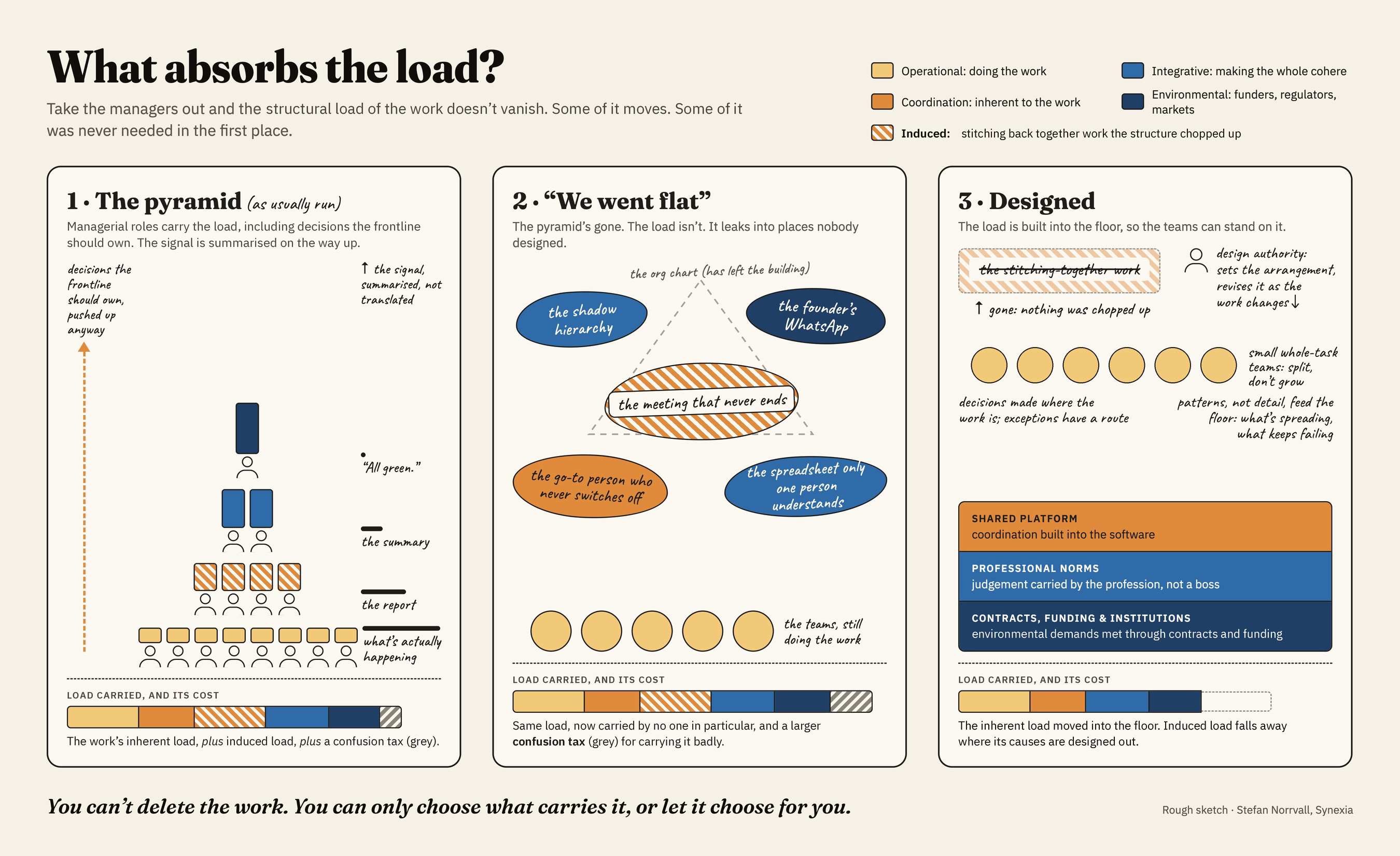
Changing the organisation chart does not remove the work. The design question is what absorbs its load, and who can change that arrangement when it stops fitting.
What the observer can see
What an observer can recognise depends on knowledge, experience, purpose and the level of description being used. None of that establishes that the demands of the work depend on the observer.
The distinction matters because understanding a situation and regulating it are different achievements. An organisation can contain all the knowledge required to recognise a problem while lacking the authority or mechanisms required to resolve it. That is where I want to take the discussion: from what the observer can see to what the arrangement can accommodate.
Understanding does not confer authority
Two operational domains may depend on the same constrained resource, with each role-holder fully understanding the competing delivery obligations. If neither role has authority to settle the trade-off, and no agreed allocation rule, contractual provision, or arbitration mechanism resolves it, the integrative load remains unabsorbed. Everyone can understand the conflict and it still needs a legitimate means of resolution.
I’ve seen this play out several times, in different ways. Most recently it was a cross-agency effort: people in operational roles doing their best to solve process-level issues at the process level, without the authority to commit either organisation to anything, and without the support they needed to make the changes stick. None of it did, until we created a legitimate channel for the work: a memorandum of understanding that let those roles work together on end-to-end process issues across both agencies.
Structure comprises roles, accountabilities, authorities, interfaces, and regulatory grammars, both declared and enacted. By regulatory grammars, I mean the rules governing how decisions are made, disturbances corrected, issues escalated, and conflicts arbitrated. Those rules may be exercised through role judgement or embedded in the mechanisms through which work proceeds.
The absence of a named arbitration role doesn’t prove that regulation is absent. A mechanism may resolve the conflict without case-by-case intervention, or an effective practice may exist that never made it into the documentation. Equally, one successful unofficial intervention tells you nothing about whether the arrangement is legitimate, repeatable or sustainable.
A mechanism can absorb the load. Authority is still required to change it when it stops fitting the work.
So the design question is what absorbs this load, under what conditions, and where authority sits to intervene when that arrangement becomes inadequate. That is a different question from who understands the situation best.
Descriptions are chosen; consequences are encountered
Choosing to examine roles, responsibility domains, or regulatory arrangements is itself a choice of description.
There is no unmediated access to organisational work. We choose boundaries, distinguish kinds of activity, trace dependencies, and select evidence. A role-level account may conceal a dependency visible only across domains. An organisation-level account may obscure differences that matter locally.
But the analyst doesn’t begin with a blank sheet. Existing accountabilities, delegations, agreements, and operating commitments establish consequential reference conditions. They may be ambiguous, contested, or inadequate. They are still more than the analyst’s modelling preferences.
Nor do they exhaust the work. A necessary dependency may sit outside every declared accountability, and delivery may depend on work the formal design neither recognises nor authorises. The inquiry has to examine both what the organisation is committed to delivering and what delivering it actually requires.
Suppose an outcome depends on acceptance by another responsibility domain. An analyst can omit that dependency from a diagram. The omission confers no acceptance authority on the delivering role and establishes no agreed acceptance mechanism. The model looks simpler; delivery still reaches the same boundary.
An experienced role-holder may anticipate the problem and negotiate acceptance early. That changes how the dependency is handled. It is no evidence that the dependency existed only because someone perceived it.
Dependence on a model for description does not establish dependence on an observer for existence.
Assessors may disagree. Then investigate the disagreement. Which dependency was omitted? Which authority exists only on paper? What actually resolves the conflict? What evidence would show that the proposed arrangement cannot accommodate the work? A diagnosis that can’t survive those questions hasn’t established a structural shortfall.
Detection is not existence
A structural shortfall may persist for years before anyone describes it adequately. Its consequences get recorded separately, as slow decisions, recurrent exceptions, rework, overloaded roles, or excessive coordination, until a diagnosis connects them through a proposed mechanism.
That mechanism needs testing. Decision latency, escalation frequency, and queue length are evidence, but none uniquely identifies a structural cause. A queue may reflect temporary demand, insufficient capacity, missing knowledge, or an authority bottleneck. Counting it won’t decide between those explanations.
A stronger diagnosis makes a discriminating claim. If the absence of an authorised means of arbitration causes recurring unresolved trade-offs, adding operational capacity should leave that decision class unresolved wherever the competing obligations persist. Establishing an adequate arbitration mechanism should change how those conflicts are handled. If it doesn’t, the diagnosis needs revision.
That mechanism might involve a designated role, an agreed priority rule, or a combination of both. The test concerns whether it resolves the relevant class of conflict under legitimate authority.
Finding the shortfall may take unusual insight. Establishing it takes evidence that others can examine. Either way, the shortfall was there before anyone found it.
Some gaps cannot be closed where they appear
Abdul’s Fixed Asset Blindness provides an illustration. In the parable he recounts, a track supervisor, Fred, kept one curve performing by running its lubricators well above specification, and never recorded it. After he retired, his successor restored the specified setting. Wear accelerated and trains were withdrawn from service.
The proposed interventions include logging overrides in work orders, walking the asset at handover, separating verified condition from desktop reconciliation, and requiring sign-off before restoring a standard setting. These address how knowledge survives a change of role-holder and how a consequential reset is controlled.
The case also raises an authority question: which role could authorise the departure, and through what route could the standard itself be challenged?
The answer changes the diagnosis. If Fred held delegated discretion, recording, handover and assurance become the immediate lines of inquiry. If a legitimate exception route existed but went unused, we need to know why. If no role within the local arrangement could authorise the departure, the work had to reach a role able to reconsider the constraint, and improved visibility at supervisor level would not by itself close that gap.
Making a departure visible and authorising its continuation are different regulatory functions. A gate on the reset controls one action; it gives no basis for retaining the departure. The remedy might be an authorised exception, a revised standard or a change to the asset. The parable doesn’t tell us which. It exposes the question design must answer.
Some gaps can be closed within the existing arrangement by exercising available authority or correcting a mechanism. Others require changes to obligations, constraints or authorities established elsewhere.
Escalation is useful only if it reaches a role able to resolve that condition. Passing the same conflict through increasingly senior meetings does not create the missing authority.
So the question can’t stop at whether the role-holder understands the work. It has to ask whether the role can legitimately act on that understanding.
What it costs to get this backwards
When a structural shortfall is diagnosed primarily as a limitation of the observer, capability development may address the wrong mechanism. You can send someone on every sense-making programme on offer; it won’t give them authority their role doesn’t hold.
Where the intended mechanisms fail to absorb required load, that load may migrate into shadow structure or wrong-level roles lacking legitimate accountability, authority, or rules for arbitration. Leaving required work unassigned or unsupported doesn’t remove the requirement. Repeated negotiation, translation, and escalation may then add induced load, producing latency, risk and burnout.
Delivery can continue through unofficial arbitration and exceptional effort in roles whose declared accountabilities don’t acknowledge that work. Continued delivery is therefore insufficient evidence of adequate design. We need to examine how it is achieved, whether the arrangement can be sustained, and where the consequences accumulate.
Assigning another role is one possible intervention. Embedding a constraint, changing a platform, revising a contract, or removing a manufactured dependency may be more appropriate. The intervention follows from the mechanism producing the shortfall.
Noting that a gap shrinks when capability grows or the situation changes doesn’t settle the design question. The design question is what must change to address this particular shortfall, and which role has the authority to change it.
What the title claims
That is where the argument about complexity becomes useful: when it distinguishes mechanisms and directs intervention. It becomes obstructive when one word allows those mechanisms to be collapsed.
Structural load keeps the required work in view. Its description can be challenged. Its placement and means of absorption are design choices. Its demands can change when the work and its conditions change.
But a dependency does not disappear because it is overlooked. An authority shortfall does not close because a role-holder becomes more reflective. Necessary integration does not cease to be work because it has been omitted from the operating model.
That is the sense in which complexity is not in the eye of the beholder.
The observer determines whether the structural shortfall is found.
The shortfall itself does not wait for the observer to arrive.
A test you can run this week
Pick one decision that keeps returning to the same meeting, and ask three questions of it. Who understands it? What actually carries it now: a role, a rule, a platform, or someone’s goodwill? Who has the authority to change that arrangement?
If the answers point to three different places, or the last one points nowhere, more capability will not fix it. You are looking at a placement problem.
I’d like to hear the cases. If you have your own Fred, someone holding work together that the design never acknowledged, tell me in the comments or reply to this email. And if you want to examine one of those decisions properly in your organisation, that is the work I do.
Thank you for sharing this and helping me understand OD better. This is not my area of expertise.
I’m particularly interested in the coordination load. This has been my experience as a manager for over 15 years and what motivated me to build a mechanism to offload some of this from my shoulders.
For lack of a better term, my co-founder and I call it “Coordination AI”. Our platform, Afoot, absorbs the coordination work a company really needs, and removes the coordination work it was creating for itself.
Afoor listens to a team's conversations, captures what was decided and who committed to what, has the people involved confirm it, and then tracks, routes and follows up on it, which is the coordination work a company really needs.
Because that confirmed record exists, the work a company was creating for itself, such as repeat meetings, status chasing and rebuilding context, no longer gets generated.
You can learn more about what we are doing here: afoot.net
Would appreciate your thoughts on the matter.